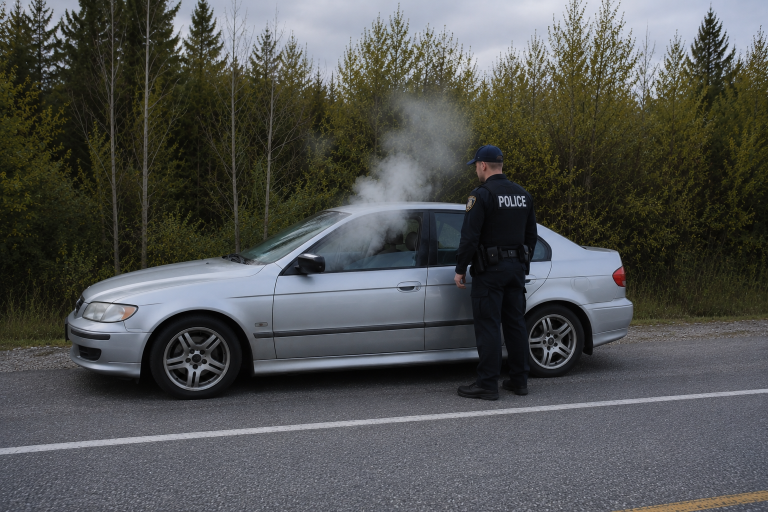
In the 2000 case of State v. Moore, the Ohio Supreme Court concluded an officer could perform a warrantless search of a vehicle if the officer smelled the odor of marijuana emanating from the vehicle. The rationale was the odor provided the officer with probable cause to believe the vehicle contained evidence of a crime. With the legalization of recreational marijuana in Ohio, that rationale is no longer valid, according to a recent case decided by an Ohio appellate court.
Officer Searches Vehicle Based on Odor
The case is State v. Lewis. A police officer stopped Lewis after he failed to stop at a stop sign and failed to signal a turn. As the officer approached Lewis’s vehicle, the officer reportedly observed the odor of burnt marijuana coming from inside the vehicle. Lewis denied having anything illegal in the car but admitted he smoked marijuana in the vehicle earlier in the day.
The officer searched Lewis’s vehicle, without his consent, and seized a loaded firearm. Lewis was indicted for Carrying a Concealed Weapon, Improperly Handling Firearms in a Motor Vehicle, and Having a Weapon While Under Disability.
Trial Court Suppresses Evidence
Lewis filed a motion to suppress evidence regarding the firearm, claiming the search was not justified. The trial judge held a hearing on the motion. The officer testified he wanted to see if Lewis was possibly under the influence. However, he did not administer field sobriety tests and did not charge Lewis with DUI (called ‘OVI’ in Ohio). The trial judge granted the motion to suppress, and the prosecution appealed to Ohio’s Eighth District Court of Appeals.
Appellate Court Affirms
In the Court of Appeals, the prosecution argued the vehicle search was justified by the ‘Automobile Exception’. That exception to the search warrant requirement applies when an officer has probable cause to believe a vehicle contains evidence of a crime. The prosecution asked the appellate court to follow precedent from State v. Moore, which held the odor of marijuana alone is sufficient to establish probable cause to search a motor vehicle.
The appellate court distinguished the holding in Moore from the facts in the current case. The Court observed possession of recreational marijuana was illegal at the time of Moore but had been legalized by the time of the current case. Referencing recent decisions from other Ohio appellate districts, the Court of Appeals concluded the odor of marijuana did not give the officer probable cause to believe a crime had been committed. Therefore, the court held, the search of Lewis’s vehicle was improper.
Application to OVI Cases in Ohio
When an officer stops a vehicle and smells the odor of marijuana, the officer may use that observation to expand the scope of the stop for the purpose of conducting an OVI investigation. According to the rationale of Lewis, the odor by itself would not be a sufficient justification to further detain the driver for an OVI investigation. In fact, the Lewis opinion quoted the Fifth District case of State v. Duch for this proposition: “Therefore, the odor of burnt or raw marijuana alone, would not be sufficient to provide a reasonable suspicion to expand the scope of the initial traffic stop in order to conduct field sobriety tests.”
About the Author: Shawn Dominy is the past President of the Ohio Association of Criminal Defense Lawyers, the state delegate to the National College for DUI Defense and a founding member of the national DUI Defense Lawyers Association. He is rated “AV Preeminent” by Martindale Hubbel®, was named by SuperLawyers® as one of the top 50 lawyers in Columbus, Ohio, and is recognized in Best Lawyers In America®for DUI defense and criminal defense.
Shawn Dominy authored the Ohio DUI/OVI Guide, the Ohio Vehicular Homicide Guide, and the Ohio Vehicular Assault Guide. He also wrote a chapter of Defending DUI Vehicular Homicide Cases (2012, West/Aspatore) and contributed a section of Drunk Driving Defense, 9th Edition (2021, Walters Kluwer). His magazine articles have been featured in state and national publications, and he is a frequent speaker at seminars in which he teaches other lawyers about DUI/OVI, serious vehicular crimes, and trial skills.
Shawn Dominy can be reached through his law firm’s website: Dominy Law Firm.
