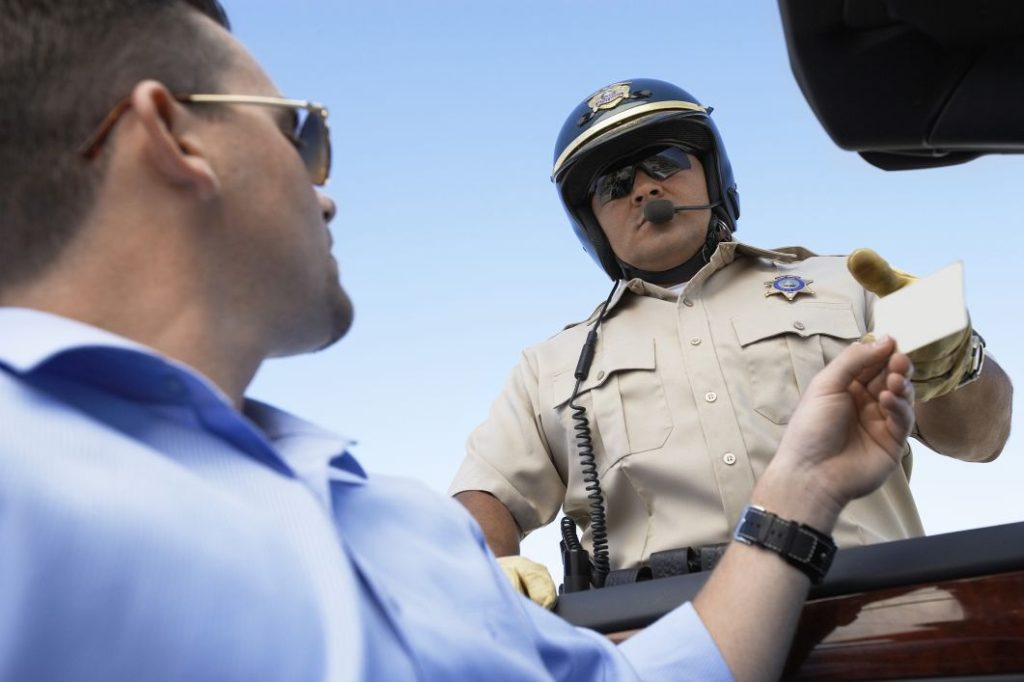
When a police officer makes a traffic stop and ultimately arrests the driver, there are separate seizures of the person for purposes of the Fourth Amendment. Those seizures are the initial traffic stop, the continued detention of the driver, and the arrest. The Ohio Supreme Court recently issued a decision in a case involving the continued detention of the driver.
Initial Seizure
The right to be free from unreasonable searches and seizures is guaranteed by the Fourth Amendment to the United States Constitution. That right is also protected by Article I, Section 14 of the Ohio Constitution. Accordingly, searches and seizures must be conducted pursuant to a warrant or one of the narrowly-drawn exceptions to the warrant requirement. The term ‘seizure’ applies to the seizure of property and the seizure of a person.
A traffic stop is a seizure. For a traffic stop, a warrant is not necessary if the officer has probable cause to believe a traffic violation has occurred or is occurring. A warrant is also unnecessary for a traffic stop if the officer’s observations reasonably lead the officer to suspect the driver’s behavior is a violation of the law.
Continued Seizure
After a valid traffic stop occurs, if the officer continues to detain the driver for an investigation unrelated to the initial stop, the continued detention must be separately justified. The continued detention is generally justified if the officer has a reasonable suspicion of criminal activity.
But what happens when the officer learns he was wrong about the reason for the traffic stop but continues the detention to investigate the driver? That question was answered in the recent case of State v. Fips.
Continued Seizure After Erroneous Stop
In Fips, two officers stopped the defendant’s vehicle for an inoperative headlight. The first officer talked with the driver and told him to “hang tight” while the officer checked his license. The second officer observed the headlight was actually working. The second officer informed the first officer the headlight was actually working. The second officer then seemed unsure about that.
The first officer ran the driver’s license and learned the driver had a suspended license and an arrest warrant. The first officer arrested the driver, searched the vehicle, and found crack cocaine. The driver was convicted for Drug Possession and ultimately appealed his conviction to the Ohio Supreme Court. The driver argued the continued detention for the officer to run the driver’s license was unconstitutional after the officer learned the headlight was not inoperable.
Ohio Supreme Court Decides the Issue
The Ohio Supreme Court concluded the continued detention was lawful. The Court cited the case of Rodriguez v. United States for the proposition that, after a valid traffic stop, an officer is entitled to complete the mission of the traffic stop, including checking the driver’s license. The Ohio Supreme Court opined that, in this case, the officer was justified in checking the driver’s license, even though the justification for the initial stop has been dispelled.
The Court’s application of Rodriguez seems a bit misplaced. At the time of the continued detention in Rodriguez, the justification for the initial stop was still valid. At the time of the continued detention in Fips, the justification for the initial stop was not still valid. It seems that, once the officer learned the initial stop was erroneous, the officer had no justification to further detain the driver for the purpose of checking the driver’ license.
How State v. Fips Applies to OVI Cases
Most DUI cases (called ‘OVI’ in Ohio) begin with a traffic stop. During the traffic stop, an officer may further detain the driver if the officer observes evidence which leads the officer to suspect the driver is under the influence. But what if the officer learns he was mistaken about the reason for the initial stop before obtaining the evidence of OVI? Based on the decision in Fips, it seems the Ohio Supreme Court may conclude the officer can continue with an OVI investigation despite learning the initial stop was erroneous.
About the Author: Shawn Dominy is a leading DUI/OVI lawyer in Ohio and the founder of the Dominy Law Firm in Columbus, Ohio. The Dominy Law Firm is recognized in Best Law Firms In America® for DUI defense and criminal defense and holds an A+ rating with the Better Business Bureau.
Shawn Dominy is the past President of the Ohio Association of Criminal Defense Lawyers, the state delegate to the National College for DUI Defense and a founding member of the national DUI Defense Lawyers Association. He is rated “AV Preeminent” by Martindale Hubbel®, was named by SuperLawyers® as one of the top 50 lawyers in Columbus, Ohio, and is recognized in Best Lawyers In America®for DUI defense and criminal defense.
Shawn Dominy authored the Ohio DUI/OVI Guide, the Ohio Vehicular Homicide Guide, and the Ohio Vehicular Assault Guide. He also wrote a chapter of Defending DUI Vehicular Homicide Cases (2012, West/Aspatore) and contributed a section of Drunk Driving Defense, 9th Edition (2021, Walters Kluwer). His magazine articles have been featured in state and national publications, and he is a frequent speaker at seminars in which he teaches other lawyers about DUI/OVI, serious vehicular crimes, and trial skills.
Shawn Dominy can be reached through his law firm’s website: Dominy Law Firm.
